Furnace Repair vs. Replacement: What Olathe Homeowners Should Consider
By Olathe Heater Repair · ·
At some point every furnace prompts the same question: is another repair worth it, or is this the moment to replace? It usually arrives at the worst possible time — cold house, evening, a number quoted at the kitchen table.
There's no single formula, but there is a reasonable way to think it through. Here are the factors that actually matter, without the sales framing.
Start with age, but don't stop there
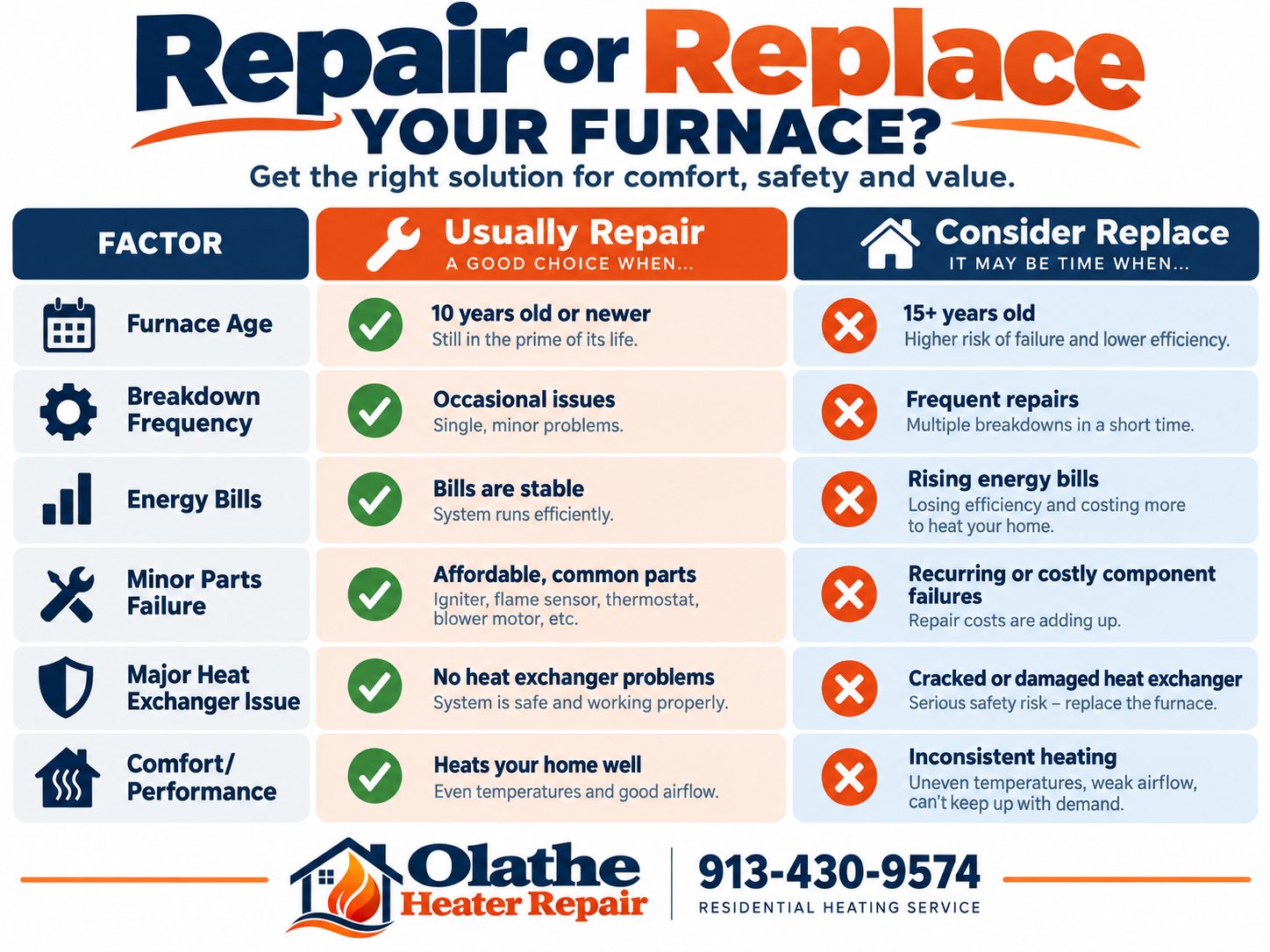
Most residential gas furnaces last fifteen to twenty years. Within that range, maintenance history matters more than the calendar. A furnace that had its burners cleaned and its components checked every fall can easily outlive one five years younger that was never touched.
Rough framing: under ten years, repair is almost always the right call and the equipment should have plenty of life left. Ten to fifteen, repair usually still wins, though the size of the repair starts to matter. Fifteen to twenty is genuinely the grey zone, where a significant repair deserves a real comparison. Past twenty, most repairs are buying time rather than solving anything — which is sometimes exactly what you need.
Age alone is never a reason to replace a working furnace. Anyone leading with the manufacture date rather than the fault is selling.
Repair history and frequency
One repair in ten years is normal. The third repair in two winters is a pattern, and the pattern matters more than any individual invoice.
Pay attention to whether failures are clustering in the expensive components — inducer motor, blower motor, control board, gas valve. When several of those go in sequence, the system is telling you something, and continuing to replace them one at a time gets expensive without ever producing a reliable furnace.
Also count the disruption. Two no-heat nights a winter has a cost that doesn't show up on an invoice.
The cost of this specific repair
The common rule of thumb multiplies the furnace's age in years by the repair cost, and suggests replacement if the result exceeds the cost of a new system. A $600 repair on a ten-year-old furnace gives $6,000 — likely under replacement cost, so repair. The same repair on an eighteen-year-old furnace gives $10,800, which probably isn't.
Treat that as a conversation starter. It ignores your plans for the home, whether the current system actually heats comfortably, and whether there are safety findings. Use it to frame the question, not to answer it. The cost estimator can give you a planning range for the repair side of that comparison.
Safety findings change everything
A confirmed cracked heat exchanger is the one factor that overrides the rest. A crack can allow combustion gases, including carbon monoxide, to mix with the air circulating through your home. A furnace with a confirmed crack should not run.
Exchangers can sometimes be replaced, and occasionally a manufacturer's warranty covers the part. But the labor is substantial — the furnace is largely disassembled — and on an older system that labor frequently approaches the cost of a new furnace with a full warranty. That is usually where the replacement conversation becomes unavoidable.
A crack should be confirmed through actual inspection and testing, and you're entitled to see what was found. A cracked heat exchanger is also the single most commonly claimed finding in high-pressure sales situations, so a second opinion is entirely reasonable.
Comfort and efficiency
Beyond breakdowns, consider how the system actually performs. Rooms that never warm up. Large temperature swings between cycles. A blower loud enough to interrupt conversation. Heating bills climbing year over year against similar weather.
Older single-stage furnaces run full blast until setpoint, then shut off — which produces noticeable swings. Modern two-stage and modulating equipment runs longer at lower output, which is quieter and more even. If comfort problems are a daily annoyance, that belongs in the decision alongside the repair cost.
One caveat worth knowing: if the duct system is undersized or leaky, a new furnace won't fix uneven heating. Ductwork is a separate problem and should be evaluated as one.
How long you plan to stay
If you're selling within a year or two, a reasonable repair that keeps the system running safely often makes more sense than a replacement you won't benefit from. Buyers do notice a new furnace, but rarely enough to return its full cost.
If this is a long-term home, the calculation flips. Ten more years of repairs on an aging furnace generally costs more than replacing it once and being done — plus a decade of better comfort and no January failures.
How to spot replacement pressure
- A replacement recommendation before any diagnosis of the actual fault
- A price that expires today
- Heavy emphasis on age with no explanation of what failed
- A claimed cracked heat exchanger you're not shown or told how it was confirmed
- Refusal to quote the repair option at all
- Financing paperwork produced before the diagnosis is explained
A good service visit tells you what failed, what the repair costs, what replacement would cost, and which one makes more sense for your situation — then lets you decide without a clock running.
Putting it together
Repair usually makes sense when the furnace is under fifteen, the repair is proportionate, there are no safety findings, it has generally been reliable, and it heats the home comfortably.
Replacement deserves serious weight when the system is past fifteen and facing a major repair, when safety findings are confirmed, when failures are clustering, when comfort is consistently poor, or when you plan to stay in the home long enough to benefit.
And when the honest answer is "this repair will hold for now, start planning for spring" — that's a legitimate recommendation too. If you'd like an actual diagnosis before deciding, request service or see what a furnace repair visit covers.
Want a straight answer about your furnace?
Diagnosis first, recommendation second. Call for a free quote and 24/7 service availability in Olathe.
Please have your 5-digit ZIP code ready. Call 913-430-9574.
Frequently asked
How long does a furnace usually last?
Is there a rule for when repair stops making sense?
Does a cracked heat exchanger always mean replacement?
Should I replace a working furnace just because it's old?
Will a new furnace lower my heating bills?
What if I can't afford either option right now?
Keep reading
No heat? Help is available 24/7.
Call now for a FREE quote and service availability.
Please have your 5-digit ZIP code ready.