How Often Should Olathe Homeowners Change a Furnace Filter?
By Olathe Heater Repair · ·
The furnace filter is the cheapest part of a heating system and the one most responsible for avoidable service calls. A five-dollar piece of pleated paper, ignored long enough, produces symptoms that look expensive.
Why the filter matters more than it looks
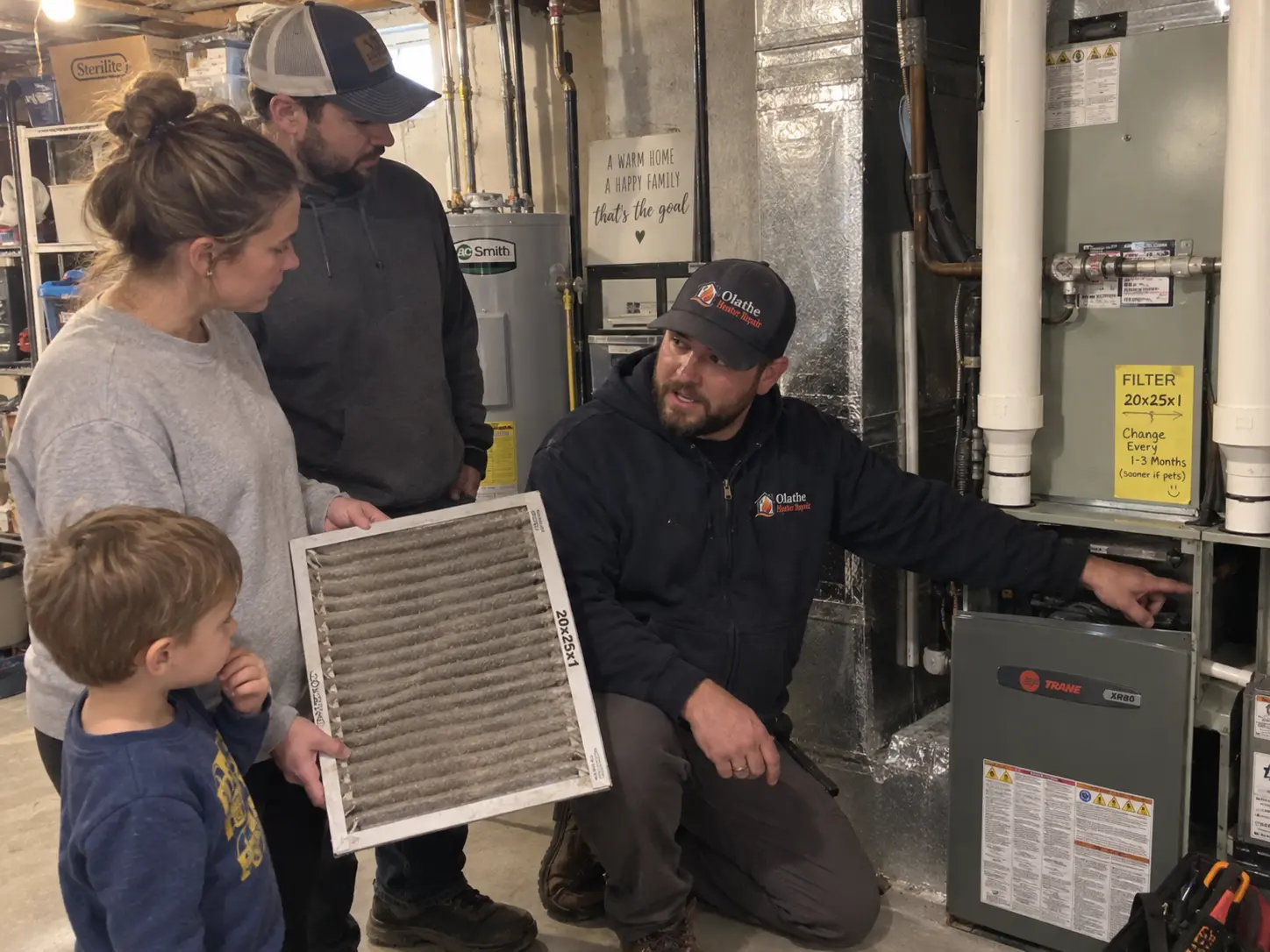
People generally think of the filter as an air-quality device. It does help with dust, but its primary job from the equipment's point of view is protecting the blower and heat exchanger from accumulating debris.
A furnace is engineered around a specific volume of air moving across the heat exchanger. As a filter loads with dust, that volume drops. Less air means the exchanger gets hotter than intended, and when the temperature crosses a threshold, the high limit switch shuts off the burners to protect the equipment.
The blower keeps running to cool things down, the furnace restarts, and the cycle repeats. That's short cycling — uneven heat, rooms that never quite warm up, and steady wear on igniters, motors and boards. The filter caused all of it.
Change intervals by filter type
1-inch fiberglass filters
Every 30 days during the heating season. These are the cheapest option and they capture the least; their real purpose is keeping large debris out of the blower. They clog fast.
1-inch pleated filters
Every 30 to 90 days. The pleats add surface area and they filter meaningfully better, but an inch of depth is still not much capacity. In a Kansas winter with the system running hard, plan on monthly checks and replacement at 60 days in most homes.
4-inch and 5-inch media filters
Every 6 to 12 months. These cabinet-mounted filters hold several times the dust of a 1-inch filter before airflow suffers. They cost more per filter and less per year, and they are easier to live with because the interval matches how often people actually remember.
Washable filters
Rinse monthly and — this is the part that gets skipped — let them dry completely before reinstalling. A damp filter going back into the return is an invitation to biological growth in the duct system.
What shortens the interval
- Pets. Dogs and cats that shed will roughly halve the useful life of a 1-inch filter.
- Ongoing renovation. Drywall dust destroys filters quickly and gets into everything downstream. Change filters frequently during any project and once more after.
- Allergies or asthma in the household. Not because the equipment demands it, but because a loaded filter stops doing its air-quality job well before it restricts airflow enough to bother the furnace.
- Continuous fan operation. If the thermostat fan is set to ON rather than AUTO, air moves through the filter around the clock.
- Unpaved roads, fields or heavy construction nearby. Parts of Olathe west toward K-7 and south toward Gardner see noticeably more airborne dust.
Choosing a MERV rating
MERV measures filtration efficiency. Higher numbers capture smaller particles — and restrict more airflow.
- MERV 1–4: minimal filtration, primarily equipment protection.
- MERV 5–8: a sensible balance for most residential systems.
- MERV 9–12: better fine-particle capture; fine on systems designed for it.
- MERV 13+: high filtration, and genuinely risky in a typical residential duct system without verifying the equipment can handle the pressure drop.
Buying the highest MERV on the shelf is a common and well-intentioned mistake. If the blower can't pull enough air through it, you've traded better filtration for limit-switch shutdowns. When in doubt, MERV 8 to 11 is the safe residential range.
How to change it correctly
- Turn the furnace off at its power switch.
- Locate the filter — in the blower compartment, a return-air grille, or a filter cabinet.
- Note the size printed on the frame before removing it.
- Slide the old filter out, keeping it flat so debris doesn't dump into the duct.
- Install the new filter with the airflow arrow pointing toward the furnace, away from the return duct.
- Seat the blower panel squarely — a misaligned panel trips the door safety switch.
- Restore power and write the date on the filter frame.
Symptoms of a neglected filter
- Weak airflow from supply registers
- Rooms farthest from the furnace never reaching setpoint
- Short cycling — heat for a few minutes, off, repeat
- Higher-than-usual gas or electric usage for similar weather
- Visible dust accumulating quickly on surfaces and around registers
- The blower running noticeably louder as it strains
If you see these and a fresh filter doesn't resolve them within a cycle or two, something else is restricting airflow — a dirty blower wheel, collapsed flex duct or closed dampers — and that's worth a look. See the short cycling guide.
Olathe seasonal notes
Two moments matter most here. The first is late September or early October, before the furnace starts running regularly — fresh filter, test run, deal with anything odd while it is still an inconvenience rather than an emergency. The second is mid-January, roughly the point where a 1-inch filter installed in the fall has done its work.
Spring cottonwood and fall harvest dust both load filters faster than people expect in this part of Johnson County. Checking monthly costs nothing and takes thirty seconds. A seasonal tune-up covers the parts of airflow you can't see.
Filter clean but still no heat?
Residential heater repair in Olathe is available 24/7. Call for a free quote and service availability.
Please have your 5-digit ZIP code ready. Call 913-430-9574.
Frequently asked
How often should I change a 1-inch furnace filter?
What about 4-inch or 5-inch media filters?
Is a higher MERV filter always better?
Which way does the arrow point?
Can a dirty filter actually stop the furnace?
Does a clean filter lower my heating bill?
Keep reading
No heat? Help is available 24/7.
Call now for a FREE quote and service availability.
Please have your 5-digit ZIP code ready.